

Aircraft Seat Belt Buckles: The Mechanism Inside
The typical seat belt buckle on a passenger aircraft works entirely mechanically: The metal tongue at one end of the belt is inserted into the buckle at the other end. Inside the buckle, a spring-loaded locking element engages with the opening in the tongue and holds it securely in place. To open the buckle, the visible lift lever is raised. This releases the locking mechanism and allows the tongue to be pulled out. This so-called lift-lever mechanism is easy to operate and familiar to many travelers because of its distinctive clicking sound. However, the exact design may vary depending on the aircraft, seat, and restraint system.
What Parts Make Up an Aircraft Seat Belt Buckle?
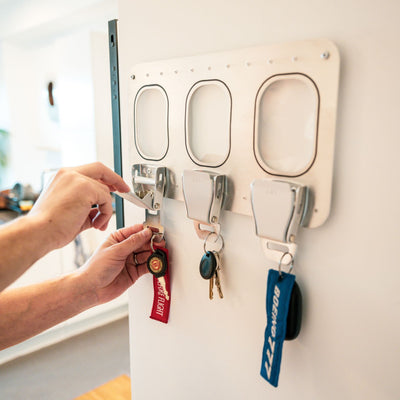
On a typical passenger seat, the safety belt consists of two belt straps that together form a lap belt running across the pelvis. At one end is the flat metal tongue, while the other end features the actual buckle. The buckle usually has a clearly visible metal lever that can be lifted upward.
The main components are:
-
two durable belt straps,
-
a metal tongue with an opening,
-
a buckle housing,
-
a spring-loaded locking element inside,
-
a lift lever for releasing the buckle,
-
an adjustment mechanism for the belt length.
The shape of the components and exactly how they interact depend on the manufacturer and the approved belt system. However, the basic principle remains similar for many conventional passenger seat belts: insert the tongue, lock it mechanically, and release it again by lifting the lever.
How the Seat Belt Buckle Is Fastened
To fasten the seat belt, the tongue is pushed into the designated opening in the buckle. As it is inserted, it initially moves the spring-loaded locking element out of its original position. Once the tongue has been inserted far enough, the locking element engages with its opening. The click that can often be heard occurs when the mechanism locks into place.
The belt should then be adjusted according to the airline’s instructions. Usually, this is done by pulling on the free end of the belt strap until the lap belt fits snugly but comfortably. The UK Civil Aviation Authority (CAA) recommends adjusting the belt so that it is tight and comfortable and keeping the buckle accessible. The safety instructions provided by the crew and the onboard demonstration always take precedence.
How the Lift Lever Opens the Seat Belt Buckle
When the lift lever is raised, its movement is transferred to the internal locking mechanism. The locking element is moved out of the opening in the tongue. Once this positive mechanical connection is released, the tongue can be pulled out of the buckle.
In simplified terms, opening the buckle takes place in three steps:
-
The passenger raises the lift lever.
-
The lever moves the internal locking element into the release position.
-
The tongue is released and can be pulled out.
The mechanism normally requires neither electricity nor sensors. However, this does not mean that every seat belt buckle is technically identical: Depending on the seating position and certification, modern aircraft seats may use different restraint systems, such as additional shoulder harnesses or airbags integrated into the lap belt.
Why Do Aircraft Often Use Lap Belts?
Many conventional passenger seats use two-point lap belts. They run across the pelvis and hold the passenger in the seat. This is particularly important during unexpected aircraft movements, for example during turbulence.
The specific equipment of a seat is not determined solely by the visible design of the seat belt buckle. The seat, belt, attachment points, and surrounding cabin form part of a tested restraint system. For commercial aircraft, the European certification specifications CS-25 and the U.S. regulations in 14 CFR Part 25, among others, contain requirements for seats, safety belts, and restraint systems.
For this reason, statements regarding load capacity or certification can only be made for the respective tested complete system. A visually similar buckle used outside an aircraft is therefore not automatically an approved aviation component.
![The Hype Is Real – Flugzeugmöbel wie Wandbars, Flugzeugmöbel und Aviation Schlüsselhalter für zu Hause [AI]](http://aircraftwindows.de/cdn/shop/articles/The_Hype_Is_Real_Flugzeugmoebel_fur_zu_Hause.png?v=1791548396&width=1254)
![Flugzeugfeeling für zu Hause mit Flugzeugmöbeln wie Wandbars Schlüsselhaltern Bord Boxen und Flugzeugfenstern [AI]](http://aircraftwindows.de/cdn/shop/articles/Flugzeugfeeling_fur_zu_Hause_mit_Flugzeugmobeln.jpg?v=1791479827&width=2000)