

Expert knowledge about aircraft details
Airplanes appear clear and functional at first glance. But the closer you look, the more small details you notice that are often overlooked – even though they play an important role. You'll encounter many of these subtleties on every flight: at the window, in the cabin, or in the aircraft's structure. They may seem inconspicuous, but they are part of a well-thought-out overall design.
1. Why airplane windows have a dark border
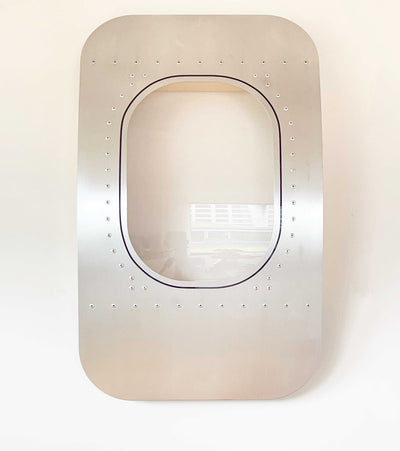
The dark border around the aircraft window serves more than just an aesthetic purpose. It protects sensitive joints between the glass and frame from UV radiation and helps to distribute material stresses more evenly. Especially at high altitudes, strong sunlight acts directly on the material. The dark border reduces this stress and contributes to the long-term stability of the window. At the same time, it ensures that transitions appear clean and technical connections are less visible.
2. Why wings visibly bend in flight
One detail many notice when looking out the window: the wings move. They flex upwards during flight – and this is intentional. Airplanes are designed so that the wings can react flexibly to stresses. During takeoff, in turbulence, or during flight, enormous forces act on the wings. The flexing helps to absorb and distribute these forces. Rigid wings would be damaged more quickly. The visible movement is therefore not a problem, but a sign that the system is functioning as intended.
3. Why airplane windows often fog up during takeoff
During takeoff, the pressure and temperature in the cabin change rapidly. This can cause moisture from the air to condense on colder surfaces – especially the windows. This effect often only occurs briefly and disappears once conditions stabilize. Depending on the seat location, outside temperature, and humidity, the condensation may be more or less pronounced.
4. Why the lights are dimmed during takeoff and landing
Shortly before takeoff and landing, the cabin lights are often dimmed. This has a simple reason: to allow passengers' eyes to adjust to the light conditions outside the aircraft. In case of an unexpected situation, their eyes can adapt more quickly to darkness or daylight. At the same time, the view outside is preserved better, as reflections in the windows are reduced.
5. Why airplane windows are never completely flush
Aircraft windows are slightly recessed into the cabin wall. This design serves both technical and practical purposes. It allows for the arrangement of multiple panes, each performing different functions. Simultaneously, it better distributes the forces generated by pressure differences. From the user's perspective, this also offers advantages: the view to the outside is slightly altered, and the window appears visually deeper and more structured.
6. Why airplane doors work differently than normal doors
An often overlooked detail: Airplane doors function differently than regular doors. They open inwards and then move outwards. This is due to cabin pressure. During flight, the pressure from the inside out forces the door against the frame. This creates an additional safety mechanism that prevents it from opening during flight. Only when the pressure is equalized can the door be moved.
7. Why you can sometimes see multiple panes in a window
Aircraft windows consist of several layers. Depending on the lighting conditions or viewing angle, these individual panes can become visible. This is because each layer fulfills its own function – from pressure absorption to inner lining. Light is refracted differently at the interfaces, making the layers discernible.
Conclusion: Small details make the difference
Many of these details seem inconspicuous at first glance. Only upon closer inspection does it become clear how ingeniously an aircraft is designed. Whether windows, wings, or cabin – every element has a clear function. It is precisely this combination of technology and design that makes aviation so fascinating.

![[AI]](http://aircraftwindows.de/cdn/shop/articles/Geschenkideen_fur_Flugzeugfans_Piloten_und_Flugbegleiter_621c2d5b-2e36-409a-bc6c-0036a8d264c2.png?v=1791097405&width=1193)